Describe the Three Parts of a Dental Hand Instrument.
Has 1 shank and 1 working end. Chapter 34 Worksheet Dental Hand Instruments 1.

Chapter 34 Dental Hand Instruments Flashcards Quizlet
And the third describes the angle of the blade in relation to the shaft and is.

. It consists of three figures sometimes four. Portion of the instrument that the operator hold grasps. Chapter 34 DAS 125 Dental Hand Instruments Hand Instrument Design 3 Basic Parts.
Because many dental instruments look similar and can be confusing to a student the false friends sub-sections identify instruments that may resemble the particular instrument. Angle of blade in degrees in relation to handle. Spoon excavator used for removal of soft Dentin degrees Decay from the tooth.
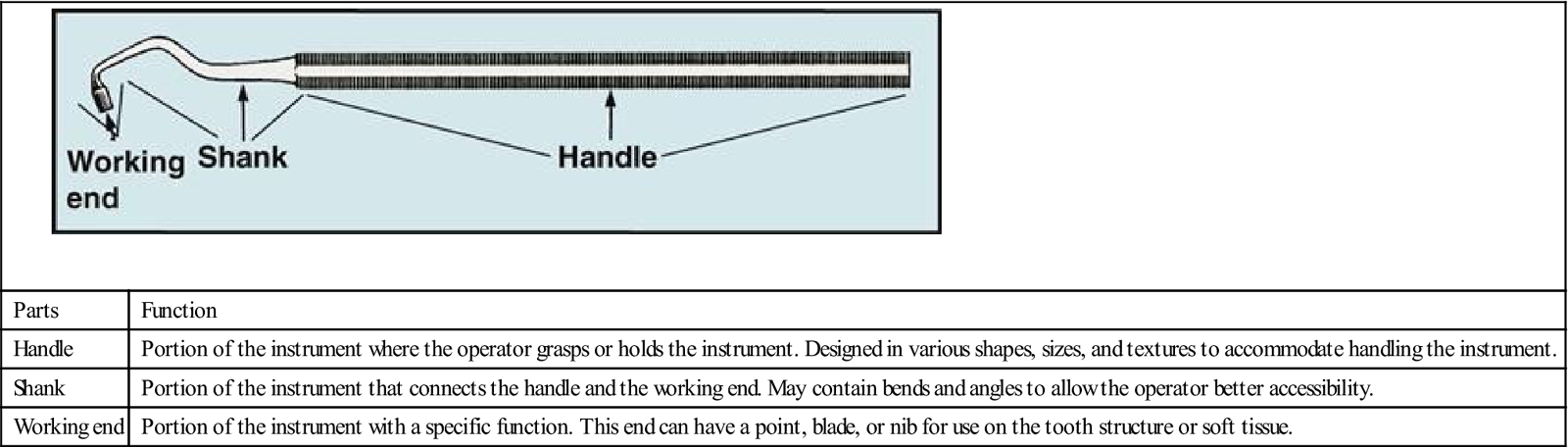
Blunt point or tip. Part of the instrument that attaches the working end to the handle. Part of a dental instrument that is used on the tooth or when dental materials are mixed.
Gingival Margin Trimmer used to cut enamel and to place bevels along the gingival enamel margins of the preparation. Each hand instrument is composed of three parts. Used to smooth the surface of a freshly placed amalgam restoration.
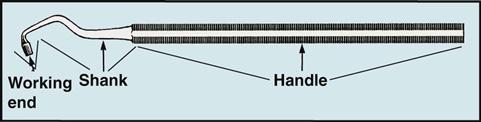
The instrument formula describes the dimensions and angulation of the instrument. D e n t a l. Handle o where the operator grasps and holds the instrument o Different shapes and sizes round hexagonal smooth grooves o Padding provides operator with greater control and less fatigue in fingers and hand muscles.
Part of the instrument that connects the working end to the handle c. Angle of blade in degrees in relation to the handle. Portion of the instrument designed for a specific function.
PartsDental is a division of Dentals Inc. Hand instruments are used extensively in cavity preparation. Handle shank working end.
Some instruments have a blade on both ends of the handle and are known as double ended instruments. Having a sense of touch or feeling. Left and right instruments.
Elevators used to extract a tooth from the mouth. Having notch like projections that extend from a flat surface. On the handle are two numbers.
Give the four instrument classifications and describe how the dental assistant would sequence instruments for the restoration of a tooth. The handle the shank and the blade. Each hand instrument is composed of three parts.
The second denotes the length of the blade in millimetres. The handle can be small medium or large smooth or serrated. Black spoon has a flat appearance but is used for the same purposes.
Portion of the instrument where where the operator holds the instrument. Is the working end of the instrument and is connected to the shank. 3 different working ends.
The three parts include the handle shank and. 1 Double-ended instrument illustrating three component parts of hand instruments. Spoon Excavators EXCAVATOR DENTAL.
One is the instrument formula and in this case it is 15-8-12. Examination Instruments Hand Cutting Instruments Restorative Instruments Accessory Instruments. Describe the 3 parts of a dental hand instrument.
Used to place the amalgam into a preparation. Portion of instrument designed for specific function. For the highest quality replacement parts for the handpiece equipment and tooling.
Instruments with 2 working ends that are mirror images of each other allowing for adaptation to. The handle the shank and the blade. The first figure denotes the width of the blade in tenths of millimetres.
Excavator used to remove soft dentin debris and decay from the tooth. If the number is 90 the working tip blade. Portion of the instrument with specific function.
Give three parts of a dental hand instrument. Blade a shank b and handle c The blade or nib. The ______________ is the portion of a dental instrument that is used on the tooth surface or for mixing dental materials.
Hoe used to prepare the tooth and to plane the walls and floors of the tooth. Part of the instrument that connects the working end to the handle. Bends or angles designed so instrument can reach specific areas of tooth.
Hand cutting Instruments are used in 3 ways as. Purpose of bends or angles in the shank. This manual is not intended to be a complete representation of all dental instruments but it does include examples from each dental discipline.
Name the 3 parts of hand instrument and give a short description of each. The term Dental Instruments refers to a wide variety of highly specific instruments held in hand and applied during the actual restoration sequence. The double-ended instrument designed with wells on either end that is used to pack freshly mixed amalgam and carry it to the prepared tooth.
Hand instruments are designed with three specific part. Portion of the instrument that the operator grasps b. Name these hand cutting instruments.
Chracterized by an angle of a surface that meets another angle. Hand instruments are designed with three specific parts. Handle shank working end.
A Division of Dentals Inc. Means to have a sense of touch or feeling. Has 2 shanks and 2 working ends.
A number of instruments of different designs are used for performing different tooth cutting and caries-removing procedures on various surfaces of different teeth and in different parts of the mouth. Handle shank working end A dental hand instrument has a working end which refers to the portion or part that actually does the specific function of the instrument a handle where the dentist uses grasp the instrument and a shank which is the part linking the handle an the working end. Condenser Plugger- Smooth and Serrated.
Having a sense of touch or feeling. Skillful application of sharp hand and rotary cutting instruments requires ability and coordination gained only by extensive training. Flat edge of instrument sharp enough to cut.
A method of defining dental hand instruments devised by G. Hand Piece also known as a.
Dental Hand Instruments Ppt Video Online Download
19 Instruments Handpieces And Accessories Pocket Dentistry
19 Instruments Handpieces And Accessories Pocket Dentistry

Comments
Post a Comment